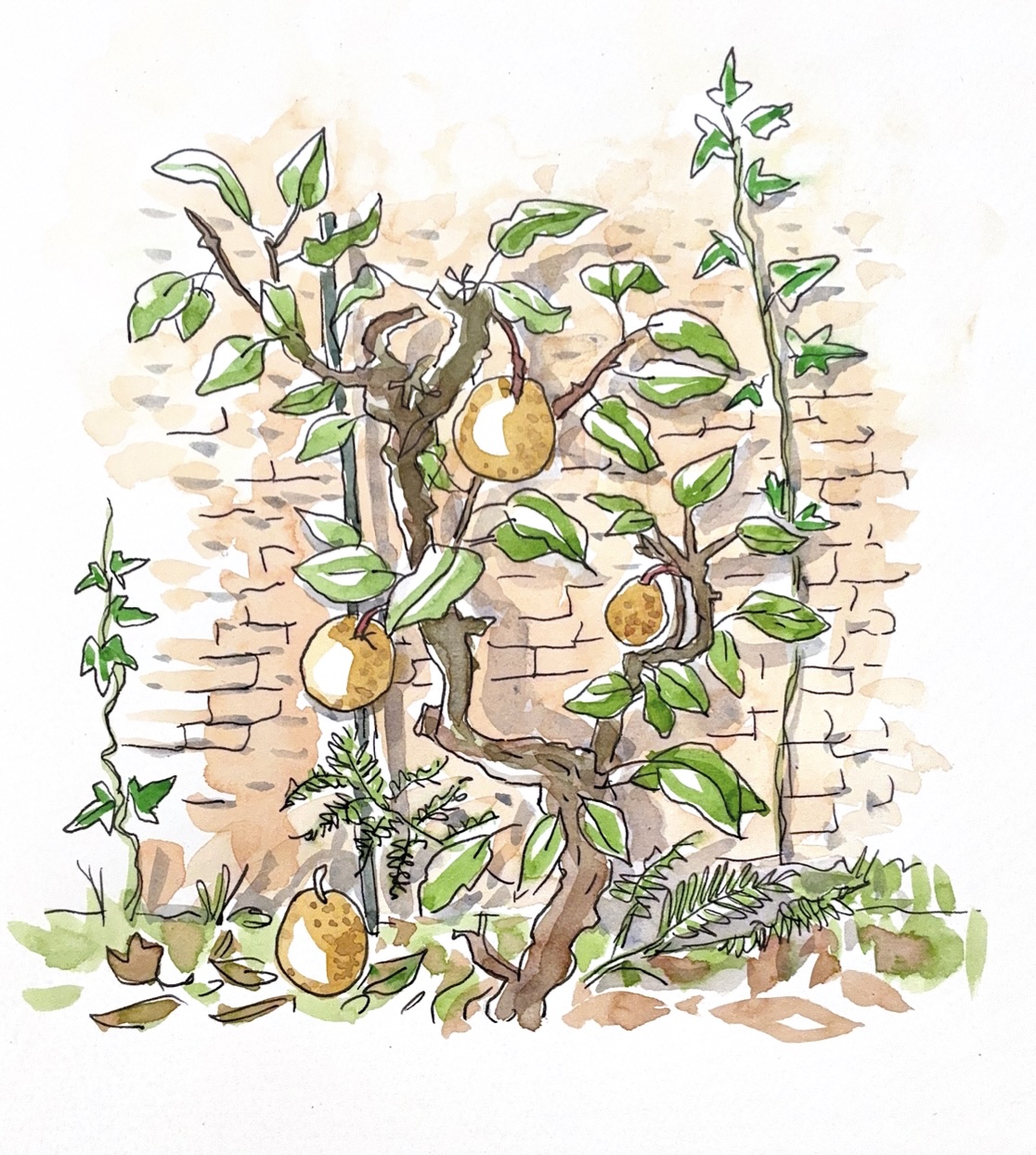
Have you heard of the nashi ? Halfway between a European pear and an apple, hence its common name of apple-pear, this fruit is given as a gift in Japan in pretty packaging, either as a New Year present or as a consolation prize to rejected lovers.
So it is with this fruit that I will end the vegetable chronicles of my blog, before starting my real gardening stories in 2026. As I got a commission from the magazine “Les Quatre Saisons” for its special issue “Les jardins familiaux” (Allotments and Community gardens) to be published in March 2026.
Before appearing on my blog, my reviews were published every month since 2017 in the magazine Versailles +, a stone’s throw from the Potager du Roi in Versailles city. The magazine contacted me when my first book was published: “Le Potager du Roi, dessins de saison à Versailles” (The king’s vegetablegarden, seasonal drawings in Versailles). They asked me to contribute to the magazine afterwards. It was a wonderful opportunity to discover forgotten or -rediscovered- vegetables, which I had begun to explore in my sketchbooks. With either my sun hat or my winter gloves, I spent seven years walking the paths of one of the France’s oldest vegetable garden. My mission ended with the lockdown in 2020, and my blog has taken over until today. And from 2026 on, stories about gardeners will take the place of those about fruits and vegetables.
But let’s not forget my old nashi, a small espaliered fruit tree in my garden that comes from Asia. In fact, the word “nashi” simply means “pear” in Japanese. Its fruits are juicier than apples and crunchier than pears. It grew vigorously in my garden. The children and I, mistaking its fruits for late-ripening pears like Passe-Crassane, would leave them on their branches until December, when they would eventually fall off from exhaustion. It was only later that I learned that nashis can remain on the tree even when fully ripe.
Rediscovered in the 1980s, the nashi is increasingly appealing to amateur gardeners because it is hardy, productive, and undemanding.
And now, over to the gardeners!